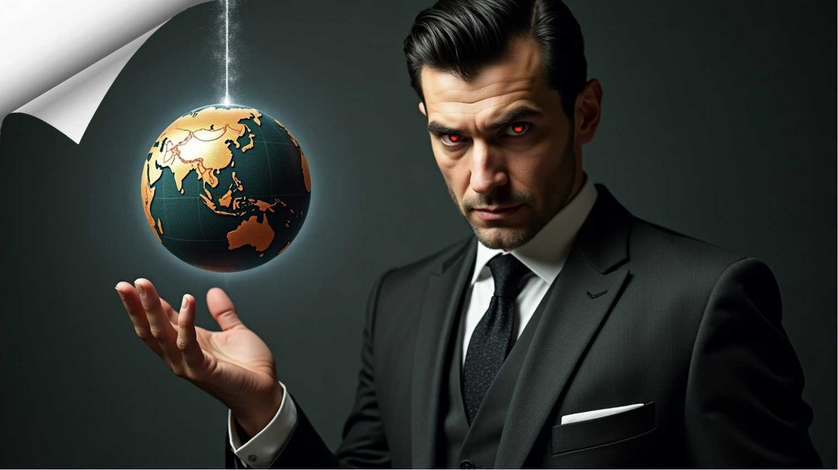
Europe Was Always Wearing a Choke Collar: What’s the difference between a happy vassal and a miserable slave? Brussels is finding out.
Once, Europe imagined it was a principled power. Now it knows better.
Europe loves to moralize. It lectures the world about law, borders, sovereignty. It speaks in principles like it invented them—then quietly treats them like optional extras.
And that worked, for a long time. It worked because Europe was never the target.
Then Trump threatened Greenland. Not coyly. Not symbolically. Not as a misunderstanding. He spoke like a boss claiming an asset: hand it over, or I’ll take it. No room for misinterpretation. No diplomatic fog. Just appetite, stated plainly.
And Europe panicked—not because it suddenly discovered coercion was wrong, but because coercion had wandered into its own neighborhood.
Because here is the part Europe will never admit: it has lived off coercion for decades. It didn’t merely tolerate the American empire. It helped run it. Europe’s leaders didn’t “fail” to see the brutality—they made it policy, and then made it polite.
Europe is not naïve. Europe is complicit.
It applauded sanctions that strangled entire societies and called it “pressure.” It endorsed proxy wars and called it “stability.” It blessed the demolition of sovereignty everywhere else—so long as it happened far away, in poor countries, to people who don’t get columns in European newspapers. When the U.S. broke nations, Europe signed the paperwork, cashed the dividend, and put on a clean suit for the press conference.
That isn’t hypocrisy by accident. That’s class interest.
Europe’s political class—career diplomats, finance ministers, think tank aristocrats, NGO executives, defense contractors—has built a whole economy around moral laundering. A priesthood of credentialed managers who translate domination into “rules-based order.” They don’t sell theft. They sell “security.” They don’t sell dispossession. They sell “stability.” They don’t sell empire. They sell “values.”
This is the virtue-hoarding class Catherine Liu calls out: people who turn morality into status, then use that status to justify the ugliest arrangements imaginable. They aren’t defending human rights. They’re defending a hierarchy that keeps them comfortable.
Europe isn’t the conscience of the West. It’s the West’s public relations department.
And like any PR department, it only panics when the client embarrasses them.
Trump didn’t threaten Greenland the way a diplomat threatens. He threatened it the way an owner threatens: as a thing to be acquired. And that should horrify anyone with a functioning moral nervous system, because Greenland isn’t empty land—it’s people, overwhelmingly Indigenous, who have already said no. But empire doesn’t recognize no. America’s history proves that. It literally fought a Civil War over the right to keep human beings as property. That mentality doesn’t disappear—it modernizes. It learns new words. It becomes “security,” “access,” “strategic interests.” It turns humans into obstacles and obstacles into paperwork. Europe knows this. Europe helped sell it. And when Trump applies it closer to home, Europe doesn’t defend Greenlandic sovereignty—it defends its own comfort. Because Europe’s real fear is not that Greenland will be colonized—it’s that Europe might finally be treated the way it has spent decades treating others: as inventory.
Trump doesn’t hide the leash. He shows it. He doesn’t dress coercion up as humanitarian concern. He speaks the truth of the system in the system’s native tongue: ownership, obedience, extraction.
That’s why the leaked messages matter so much. Not because they’re shocking—but because they’re honest. Macron’s text says more than a decade of speeches:
“My friend, we are totally in line on Syria… I do not understand what you are doing on Greenland.”
That isn’t confusion. That is entitlement.
Europe thought it had a role. It had a function.
A lapdog in a tailored suit, rewarded for loyalty, permitted to speak. It confused obedience for relevance, deference for diplomacy. And when the leash was yanked, it didn’t lose power. It realized it never had any. That’s not dispossession. That’s humiliation—on the global stage, in real time.
Europe was always wearing a choke collar.
It just never expected to get yanked.
This isn’t betrayal. It’s continuity. Europe hasn’t exercised real foreign policy independence in decades—not since France refused U.S. warplanes airspace over Iraq. That was the exception. Everything else has been ritual obedience, dressed up as shared values. Even when Trump mocked them, Europe didn’t push back. It flattered him. It begged him. It called him “Daddy.” Because the truth is, Europe never believed it was equal. It just hoped to be treated well.
It is Europe admitting: we’re aligned when you wreck others; we don’t understand when you threaten us. Syria is a project. Greenland is a violation. The issue isn’t coercion—it’s proximity.
Europe never objected to the leash. It objected to the idea that it could be collared.
So let’s end the fiction. Europe isn’t a victim of American belligerence. It’s a junior partner discovering what partnership really means.
This isn’t a knife to Europe’s throat. That framing flatters them—makes them innocent, surprised, clean. Europe isn’t clean. Europe is learning what every sanctioned, bombed, and “transitioned” country already knows: empire doesn’t have friends. It has clients. It has assets. It has dependencies.
Europe helped build the machine that punishes sovereignty. It helped normalize the idea that small nations can be managed, pressured, and stripped for compliance. It benefited from the extraction. It enjoyed the safety of being inside the club.
Now the club leader is turning around, snapping the leash, and seeing how well Europe heel-walks.
And Europe—shocked, outraged, trembling—reaches for the same empty language it used to justify coercion abroad. It calls this “unacceptable.” It calls this “threatening.” It calls this “anti-democratic.” As if those words meant anything when they were aimed at Damascus, Caracas, Tehran, Tripoli.
The world is watching, and it understands perfectly: Europe never believed in sovereignty. It believed in ownership, as long as it wasn’t owned.
So here is the only honest choice Europe has left—no more sermons, no more branding, no more sanctimony:
Europe doesn’t need louder principles.
It needs to embrace: autonomy or vassalage.
Because if you spent decades cheering tyranny abroad, don’t act surprised when tyranny comes home, slips on a collar, and calls you inventory.
Europe didn’t lose status. It lost illusion.
Europe spent decades defending the leash—until it felt it tighten.
Europe was always wearing a choke collar.
It just never expected their master to yank it so hard.